Thick Client Application Vulnerability Assessment & Penetration Test
Many organizations rely on desktop-based software applications to manage sensitive business operations, including financial transactions, healthcare records, manufacturing processes, and enterprise resource planning. Unlike web applications that operate primarily through a browser, thick client applications install directly on a user’s computer and often perform a significant portion of processing locally. While these applications provide excellent performance and advanced functionality, they also introduce unique security risks that cannot be addressed through traditional web security testing alone. This is why a thick client application vulnerability assessment & penetration test has become an essential component of modern cybersecurity programs for organizations that develop or use desktop software.
A thick client application vulnerability assessment & penetration test is a comprehensive security evaluation designed to identify vulnerabilities in desktop applications and determine whether attackers can exploit those weaknesses. The assessment combines automated vulnerability identification with manual penetration testing techniques to provide a complete understanding of the application’s security posture. Security professionals analyze the application itself, its communication with backend servers, local data storage, authentication mechanisms, encryption methods, configuration files, and interactions with the operating system. The goal is to uncover weaknesses before malicious actors have the opportunity to exploit them.
Unlike browser-based applications, thick client software often stores information locally on the user’s device. This may include configuration files, cached credentials, encryption keys, log files, or temporary data that could expose sensitive information if not properly protected. During a thick client application vulnerability assessment & penetration test, security professionals examine how the application stores and protects local data. They determine whether confidential information is encrypted, whether credentials are securely managed, and whether attackers could retrieve sensitive information directly from the user’s computer.
Authentication and authorization are major focus areas during a thick client application vulnerability assessment & penetration test. Many desktop applications connect to remote servers for user authentication, synchronization, and data exchange. Weak authentication mechanisms, hardcoded credentials, insecure session management, or improper authorization controls can allow attackers to bypass security measures and gain unauthorized access. Security testers evaluate login processes, password handling, multi-factor authentication, session tokens, role-based permissions, and privilege management to ensure users can only access resources they are authorized to use.
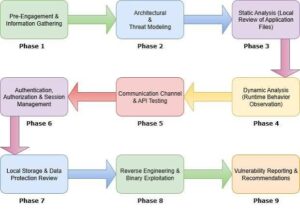
Communication security is another critical component of a thick client application vulnerability assessment & penetration test. Desktop applications frequently exchange sensitive information with backend servers through APIs, web services, or proprietary communication protocols. If these communications are not adequately protected, attackers may intercept, modify, or replay network traffic. Security professionals analyze communication channels to verify that strong encryption protocols are implemented correctly, certificates are validated properly, and data transmitted between the client and server cannot be manipulated during transit.
Reverse engineering resistance is an important consideration during a thick client application vulnerability assessment & penetration test because attackers often analyze desktop applications to discover hidden functionality, hardcoded credentials, encryption algorithms, or licensing mechanisms. Security professionals use reverse engineering tools to inspect compiled binaries, examine application logic, and identify weaknesses that could allow attackers to modify software behavior or bypass security controls. This process helps organizations determine whether code obfuscation, anti-tampering protections, and other defensive measures adequately protect the application against unauthorized analysis.
What Is a Thick Client Application Vulnerability Assessment & Penetration Test?
Input validation is another essential area examined during a thick client application vulnerability assessment & penetration test. Desktop applications frequently process user input through forms, imported files, configuration settings, and network communications. Improper validation may expose the application to vulnerabilities such as buffer overflows, command injection, path traversal, or memory corruption attacks. Security testers carefully analyze how the application handles different types of input, including unexpected or malicious data, to identify weaknesses that could result in system compromise or application crashes.
File handling security also receives significant attention during a thick client application vulnerability assessment & penetration test. Many desktop applications create, modify, import, or export files containing sensitive business information. Weak file permissions, insecure temporary storage, improper validation of imported files, or unsafe file processing routines can expose organizations to serious security risks. Security professionals evaluate how files are managed throughout their lifecycle, ensuring that confidential information remains protected and unauthorized file manipulation is prevented.
Memory security testing is particularly important for desktop applications because they execute directly on local operating systems. During a thick client application vulnerability assessment & penetration test, security professionals analyze memory management practices to identify vulnerabilities such as buffer overflows, use-after-free conditions, insecure memory allocation, or sensitive data remaining accessible in memory after use. Exploiting these weaknesses may allow attackers to execute arbitrary code, bypass security controls, or extract confidential information from running applications.
Configuration security represents another important aspect of a thick client application vulnerability assessment & penetration test. Desktop applications often rely on configuration files that define server connections, authentication settings, encryption parameters, or application behavior. Insecure default configurations, exposed administrative settings, or editable configuration files may create opportunities for attackers to manipulate application functionality. Security assessments verify that configuration files are adequately protected, sensitive settings are encrypted where appropriate, and users cannot modify critical security controls without authorization.
Modern desktop applications frequently integrate with operating system features, third-party libraries, cloud services, and external APIs. These dependencies can introduce additional security risks if not properly managed. A thick client application vulnerability assessment & penetration test examines software dependencies, identifies outdated or vulnerable components, evaluates API security, and verifies that third-party integrations follow secure communication practices. Addressing these risks helps reduce the overall attack surface while improving application resilience.
Organizations operating in regulated industries such as finance, healthcare, manufacturing, and government particularly benefit from a thick client application vulnerability assessment & penetration test because these sectors often handle highly sensitive information subject to strict compliance requirements. Security assessments help organizations demonstrate proactive risk management while supporting standards such as PCI DSS, HIPAA, ISO 27001, SOC 2, and other cybersecurity frameworks. Detailed assessment reports provide valuable documentation showing that applications have undergone comprehensive security evaluation before deployment.
Beyond regulatory compliance, conducting a thick client application vulnerability assessment & penetration test also strengthens customer confidence and business reputation. Organizations that prioritize application security demonstrate a commitment to protecting user information and maintaining reliable software. Identifying vulnerabilities before attackers exploit them reduces the likelihood of costly data breaches, operational disruptions, financial losses, and reputational damage. It also allows development teams to address security weaknesses during the software lifecycle when remediation is typically faster and more cost-effective.
Ultimately, desktop applications continue to play a critical role in supporting business operations across numerous industries, making their security more important than ever. A thick client application vulnerability assessment & penetration test provides organizations with a comprehensive understanding of the security risks affecting their applications by evaluating authentication, communication security, local data storage, memory management, input validation, reverse engineering resistance, configuration security, and software dependencies. By conducting regular assessments and addressing identified vulnerabilities, organizations can significantly improve application security, protect sensitive information, maintain regulatory compliance, and ensure their desktop software remains resilient against evolving cyber threats.
